Sunday, July 24, 2011

Animal Alphabet: Q is for Quoll (and Quetzal, too)

As it turns out, I have a drawing several years old that would work fine for this week's installment of the Animal Alphabet. I've colored it for the occasion.


That's from my abecedary entry into the "______ Are Always Fun to Draw" project from a few years ago that was, incidentally, my first introduction to the Animal Alphabet's deacon, Ben Towle. Maybe now would be a good time to mention that you can get that alphabet, plus another one with Medieval folk, in convenient micro-minicomic form, via this link.

If you're reading this and you've been contributing regularly to the Animal Alphabet, drop me a line via email (it's in my Blogger profile), and I'll send you those two little ABCs for free, just as my way to say how much fun I've been having as a contributor to the project.

Now, I like my quetzal drawing, and it was (as promised) fun to draw, way back when. But I didn't think it would be right to rest on my laurels this week, especially with so many Scrabble players checking this week's entries for ways to use their Qs.

And so, let me also present to you the largest living* marsupial predator in mainland Australia, and the second-largest living marsupial predator of all:
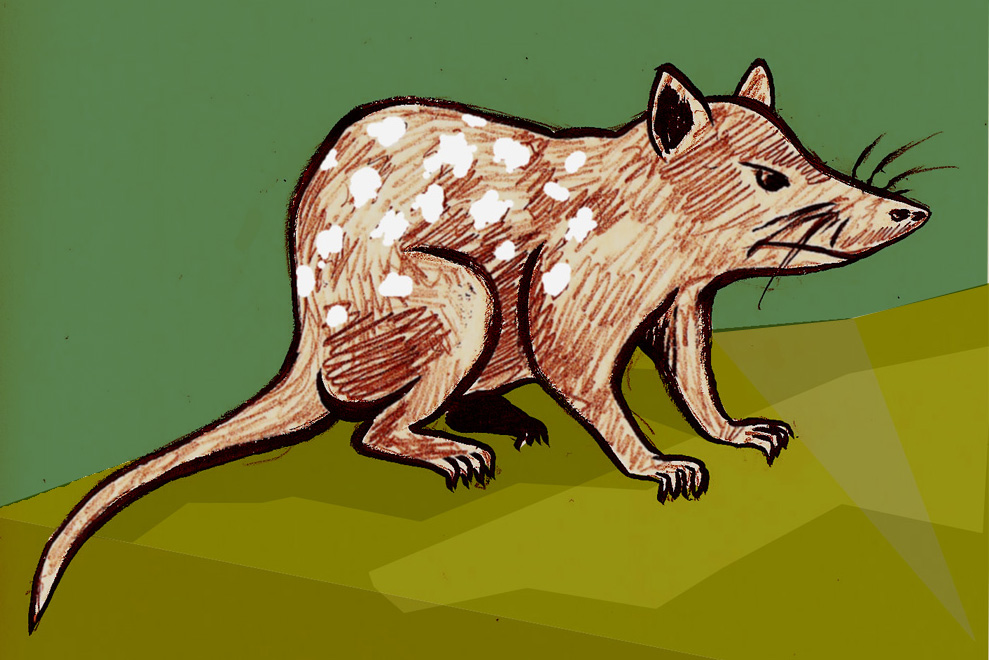


That's a tiger quoll. There are several species of quoll, all living in relatively small areas of Australia or New Guinea. They're about the size of housecats, I think, though the tiger quoll is the biggest of the bunch.

If you're wondering who the largest marsupial predator is (by weight), then please allow him to introduce himself.

I don't think my drawing actually does a good job of capturing the quoll's personality — its quollities, if you will. My initial doodles might actually have been a bit more quollified for that task.


And I kept wondering, as I thought about the quoll this week, why it starts with a Q instead of a K. There are, as I mentioned before, lots of antipodean animals whose names kick off with a K.


Have you kids met Keanu?

Why a quoll and not a kwall? Why a quokka, not a kwokka? Who can explain orthographical orthopraxis? Ah, alas.


*Speaking of "alas," the qualifier "living" has to appear in my lists of marsupial predators because of the almost certain demise, in the last century, of the thylacine, a.k.a. the Tasmanian wolf or the Tasmanian tiger. It lived long enough to be photographed, but not long enough for me to meet it. [Sadface emoticon here.]

Monday, July 18, 2011

Animal Alphabet: P is for Pangolin

This week's entry in the Animal Alphabet is "Another armored animal..."


Here's a link to an ARKive video that will show you the funny bipedal walking that Marianne Moore describes in her poem.

The pangolin is the only mammal that is covered with scales.

Real overlapping scales have evolved in four places in the history of life on earth, as far as I know. The most obvious is in a subset of the reptiles (lizards and snakes). The name of that group, the squamates, derives from the Latin word for scale.

Can you tell me the other two groups of animals that have overlapping scales? Both groups are extant, not extinct.

Sunday, July 10, 2011

Animal Alphabet: O is for Olm

This week's entry in the Animal Alphabet is the olm.

It's not the first salamander we've seen in the alphabet: Meredith Randazzo did a mudpuppy, Lupi did an axolotl, and just last week Andrew Neal did a newt. But I'd bet that this salamander might be the strangest.

I wouldn't be surprised if you haven't heard of it. It's a very rare creature, and its habitat is confined to the caves of the Dinaric karst (on the Balkan peninsula). By the people of Slovenia, it is called "the human fish," on account of its coloration, which is really a lot like waterlogged caucasian human flesh.

It also had a reputation, back in the old days, for being a newly hatched dragon. So I guess that's the second one of those that I've drawn.


As you can see, what we have here is not just an olm, but an olm ouroboros.

It's my second nearly transparent underwater critter in a row, and I'm really not having a lot of luck coloring them in Photoshop. But I couldn't say no to the olm.

I've actually been working on a poem about the olm and its ecologically threatened position; in the poem I call the olm "the eft of the fontanelle" and play off of the fact that it belongs to the Proteus family. There's more, but I can't publish the poem here because I am still trying to find a print venue for it. One factoid that didn't make it into the poem is that olms, extremely long-lived on account of their very slow metabolisms, can survive for many years (at least six, some sources say ten) without a meal.

Here is some ARKive video of the olm so you can see that serpentine little body in motion.

I had originally planned, as you can see, a more naturalistic pose for my olm.


Eventually I settled on the ouroboros image when I saw that this week's Woot t-shirt derby is on the theme of "Things that Begin with O." If you've ever bought anything from Woot, you can vote for the olm behind this link.

It looks pretty good on a t-shirt, don't you think?

Monday, July 4, 2011

Animal Alphabet: N is for Nudibranch

For the Animal Alphabet this week, I have drawn a creature I didn't even know about when the project started.

Well, actually, I've been a fan of nudibranchs for a long time. But I had never seen Melibe leonina, the hooded nudibranch (or lion's mane nudibranch), until I caught it in an episode of Blue Planet.

You can see some footage of them here, on ARKive, and I think you'll see why I might have wanted to draw them.


First of all, I wanted to try to figure out how they're put together. I have never worked through more sketches in an attempt to figure out a critter's anatomy, I tell you. It took me several drawings before I noticed those two ear-like rhinophores on the back of the hood. I'm not sure about the number of wings or flippers.

And I'm still not sure that I've managed to capture the weird translucent net-ball-hood thing that is the head of Melibe leonina.


Another reason I was drawn to them was the bizarre body plan. These nudibranchs look like something from out of the Burgess Shale, and not like something that should be alive on this planet today. And in fact these weird things are plentiful, as you can see in some of the shots in that ARKive video.

The more I drew them, the more I realized that I was recognizing bits and pieces here and there. For a while they were looking like a monster I drew frequently when I was in like third grade.

(It looked like this. It was an outer space monster, so it didn't need limbs.)


Right now, my sense is that the recipe for a hooded nudibranch is about two parts jellyfish, two parts cow's tongue, two parts venus flytrap, one part dumbo octopus, one part Pac-Man, one part slug, and one part vagina dentata.

Next week: a blind cave-dwelling creature.

Monday, June 27, 2011

Animal Alphabet: M is for Moloch

This week's Animal Alphabet entry goes by a few different names. I have a couple of other things I'm considering for T, though, so I won't be calling this a "thorny dragon" or a "thorny devil." Instead, I will give this little lizard its most awesome monicker, which it shares with one of Satan's fallen angels: it's the moloch, also known as Moloch horridus.


Seriously, I'm sort of a collector of scientific binomials—among my favorites are Gorilla gorilla and Bison bison—and Moloch horridus is about as cool as they get. Extra points for the etymological joke about the word "horrid" (which used to mean something closer to "horripilating," as you know, and seems to refer to the hundreds of thorny spikes sticking out from the moloch's hide).

The moloch is not related to the horned frog familiar to me from my Texas youth. Rather, the moloch lives in the Australian desert and is actually a lot spinier than the horny toad. Its spines are all keratin (not bone), and the texture of its skin gives the moloch the bizarre ability to wick water up from its feet to its face by capillary action. (Here's a link to a video that shows this miracle in action.)

What my drawing really doesn't capture is the weird jerky gait that the moloch uses, perhaps to confuse predators. For that, you have to refer to a different video or my preliminary doodles for this week.


"Moloch whose mind is pure machinery! Moloch whose blood is running money! Moloch whose fingers are ten armies! Moloch whose breast is a cannibal dynamo! Moloch whose ear is a smoking tomb!"

Anyway, I have a couple of creatures in mind for next week, and I'm having trouble choosing between them. Do you have a preference? I have a poll for you; you'll have to click through to vote if you're reading this by RSS.

What critter should I draw for the letter N?

Monday, June 20, 2011

Animal Alphabet: L is for Lungfish

A quick "Animal Alphabet" post this week, mostly because I don't have a lot to say.

You see, in my mental zoo, L has to be for Lungfish. Such has it always been.

Besides, it's been a while since I drew a weird fish.


I have always thought these guys are cool, since I was maybe three years old. When their ponds and pools dry up, they can hibernate under the mud, or they can slither off through the air looking for a deeper hole. I think if you grow up knowing about the existence of oddball animals like these, you're much more likely to appreciate Darwin's insights.

I realize that by doing a semi-amphibious fish this week, I'm pretty much robbing myself of "mudskipper" for next week, but I have something else planned (a lizard with an awesome name).

Monday, June 13, 2011

Animal Alphabet: K is for Kaka, Kea, and Kakapo

This week's Animal Alphabet entry is a threefer, because I couldn't decide between the three living members of the Strigopidae family.

That's right, antipodean parrot fans: this week, K is for Kaka, Kea, and Kakapo.


While I was picking a critter for this week's post, I started noticing how many of the iconic animals of Australia and New Zealand start with k. As of the point when I'm writing this, we already have Animal Alphabet entries for the kookaburra and the kiwi, and there's no reason we couldn't see the kangaroo or the koala.

I'm not sure why there are so many K-creatures down under, although I imagine it must have to do with both the prominence of the hard C in the native languages and the historical ascent of K as a way to spell that sound in English, perhaps as part of a general drift away from Latinate spellings for the things of the larger world. (After all, English had names for none of these critters before Captain Cook and Joseph Banks hit the Southern Hemisphere in 1769. That's pretty recent, in terms of the history of the language.)

Anyway, since I had decided to focus on three of the parrots peculiar to New Zealand, and since I can't think of New Zealand without thinking of its greatest cartoonist, I decided to include a local character of his (who also starts with "K") as an appropriate tour guide to the parrots.