Have I mentioned that I'm running a Kickstarter campaign, trying to finance the publication of some postcards based on last year's Animal Alphabet project?
This is what one of the postcards is going to look like, featuring Ben Towle's "O is for Ostrich" and Rich Barrett's "O is for Octopus."
It's going well already. The project has enough backers that I am surely going to take the postcards to the press. I mention it here in case it's news to you, because if I get enough support I'll be able to publish the postcards in a larger edition and more nicely.
Late Update: If you've located this post and are interested in buying a set of the cards, please visit the Satisfactory Press Storenvy site, where the cards and a selection of other goodies are available.
Showing posts with label Animal Alphabet. Show all posts
Thursday, August 16, 2012
Monday, October 3, 2011
Animal Alphabet: YUZZ is for Yuzz-a-ma-Tuzz
This week's entry in the Animal Alphabet is a real rarity. I couldn't even find any footage of David Attenborough talking about it.
The Yuzz-a-ma-Tuzz is a large furred serpentine creature that dwells among mountain outcroppings and crags. I've had to type its name with a Y, but it's actually spelled with a yuzz.

I'm not sure how much farther in the alphabet I'll be able to get. I know that on October 17 I'm going to start a new alphabet with Ben and the rest of the gang, but this time the animals will be imaginary, not real. I'm not sure why Ben decided to schedule this new alphabet when there are still eighteen letters left to go.
Monday, September 26, 2011
Animal Alphabet: Z is for Zebra Swallowtail
Last week I promised a terrifying chimera for the final week of the Animal Alphabet.
Here it is!

Yes, Z is for the zebra swallowtail butterfly, as the title of this post indicates.
Maybe you don't think it is terrifying (or chimerical). Clearly, if you think that way, you don't know how these things are made. Here is a glimpse of that unholy alchemy. Click to see it more clearly.

Rumor has it that another alphabet is about to begin, full of imaginary (rather than authentic) creatures. I am consulting my sources and limbering my digits.
Monday, September 19, 2011
Animal Alphabet: Y is for Yapok
I'm posting this late enough on Monday that I know at least my pal Ben Towle, at the very least, has already scooped my entry for this week in the Animal Alphabet.
Well, be that as it may, I say Y is for yapok.
A yapok is a South American marsupial (a sort of possum, like most if not all New World marsupials) with cool webbed feet. And its feet and hands are webbed because it does its hunting by swimming around in a river and noodling.
Aw, that's nothing, you say. Otters do it. Sure, the yapok has a cool name, but what's so special about it?
Well, think for a second: we know it's a marsupial, which means Mama Yapok carries her babies in a pouch. But she also spends a lot of time submerged. A yapok's pouch has a strong sphincter that closes it up watertight while Mama is swimming.

That's why I have drawn a yapok with a Ziploc.
Next week: a terrifying chimera.
Sunday, September 11, 2011
Animal Alphabet: X is for Xenopsylla cheopis
I'm posting this Animal Alphabet entry a day early because I am going to be in the classroom almost all day tomorrow.
Often you have to cheat a little when you get to X. One very popular ABC in our house spells fox backwards to get its X animal. Dr. Seuss just lists a few words you can use x in. Another of our favorite abecedaries basically coins a word from the Greek. And quite a few just resort to words that start with an "x" sound, like "expotition."
My cheat this time is to turn to scientific binomial nomenclature, which is full of Hellenic formulations. There's a horrid species of flower bug, for example, named Xylocoris maculipennis; it's notorious for practicing not merely traumatic insemination but male-to-male traumatic insemination, in which the aggressor's sperm migrate to the testes of the victim. There's also the death-watch beetle, Xestobium rufovillosum, the common name of which refers to the ticking sound it makes by banging its head on old furniture and old timbers.
But if you're going to do up a bug, why not go right to the top of the ladder of nastiness?
It may not be the most lethal animal on earth any more, but this week X is for Xenopsylla cheopis, the oriental rat flea, a.k.a. the plague flea.
(Clicky, enlargey.)

John Donne had no way to know what terrors a flea could really be guilty of. This nasty little guy is a disease vector both for the bubonic plague and for a strain of typhus, and when it carried the Black Death through Europe nearly half of the population died in a four-year period.
I tweaked the anatomy a bit to get the cartoon going, since I didn't just want to reproduce the standard on-its-side-on-a-microscope-slide image that other people have done better than I can. Any overly picky entomologists can have a full refund.
This is hardly the first flea to appear on the Satisfactory Comics blog. We've been "asked," in the past, to draw manga fleas. And Satisfactory Comics #5, of course, featured as its main villain the world-dominator manqué The King of Fleas.
(Maybe one of these days I'll finally post the Kang of Fleas.)
Next week: you wouldn't think you could carry a pouch there...
Monday, September 5, 2011
Animal Alphabet: W is for Weedy Sea Dragon
I think most of the end of the alphabet is going to be tough for me, not because I don't have cool animals in mind, but because the semester has started and I have so damn little time now. (Maybe this week I should have just doodled up a woodchuck. I mean, I know I have reference images...)
Why, today, I didn't even have time to color a proper background, and just stole one from the middle of somebody's photo.
Anyway, here in nearly the eleventh hour, W is for Weedy Sea Dragon.

I append a version of the drawing without the background, so you can see the critter in question just a little better. Doesn't it look implausible?

If you think that's weird, you should see its cousin, the leafy sea dragon. (Why did I choose the lungfish that week? Well, who'd have time to draw that thing?)
They're both kin to the seahorse, and they conduct some rather sweet romantic dancing when time comes for them to attract a mate.
I first learned of these oddities from a book I'd recommend to any of you Animal Alphabet fans out there: Flannery & Schouten's Astonishing Animals.
Next week: it'll give you Xs in your eyes!
Monday, August 29, 2011
Animal Alphabet: V is for Vogelkop Bowerbird
A few people have expressed concern or curiosity, so if you're reading this and are worried about how my part of Vermont weathered Irene, let me say that our house was unscathed. Irene hit here as a lot of rain and wind, but really if I hadn't been warned I'd have had no reason not to think it was just a longer-than-usual summer storm. Spend your cares instead on the Schulz Library at CCS, in a different part of the state, a lot closer to a river and with more cause for concern.
This week's Animal Alphabet critter doesn't look like much:
But, in fact, the Vogelkop bowerbird is one of the most amazing instances of the variety and splendor of the natural world.
Rather than trying to impress his mate with elaborate feathers, wattles, or dancing displays, the male bowerbird builds and decorates a structure for the female to inspect. And the Vogelkop bowerbird, more than any of its relatives, constructs an impressive and wondrous gallery, collecting colorful seeds, flowers, fungus, snail shells, beetle elytra, and even human detritus from around the forest, and arraying these collections in an area under his bower as much as five or six yards across.
Every male collects different items and arranges them according to his personal (if that's the right word) taste.
This is a pretty crummy drawing. Go look at David Attenborough investigating a real Vogelkop bower.
I think you will agree with me on this point: if you were walking through the Vogelkop peninsula of New Guinea without any knowledge of the bowerbirds, and you encountered one of these structures with its array of ornaments and its piles sorted with obvious regard to aesthetics, you'd believe it was made by a human. Or a fairy. Or a spirit creature. Or a smurf. Something.
Next week: probably my last sea creature, and it's a doozy.
Monday, August 22, 2011
Animal Alphabet: U is for Uakari
Nothing special to say about this week's Animal Alphabet entry.
The uakari is a funny-looking monkey with a body like Hartza's and a head like a certain Nazi bedeviler of Captain America.
In other words, it looks like a tomato on a haystack.
Is this version better?
Next week: something like an art collector.
The uakari is a funny-looking monkey with a body like Hartza's and a head like a certain Nazi bedeviler of Captain America.
In other words, it looks like a tomato on a haystack.
Is this version better?
Next week: something like an art collector.
Monday, August 15, 2011
Animal Alphabet: T is for Temminck's Tragopan
Okay, here's this week's entry in the Animal Alphabet.
If you've received a postcard from China recently, you might have been wondering about the creature on this odd stamp.
That's a tragopan, with its lappet extended. (The lappet is a sort of bib-shaped wattle that the male tragopan can unfurl for territorial or mating displays. Those odd horns are made of the same tumescent stuff.) There are five species of tragopan, but only one alliterates (and therefore suits this post to a T):
T is for Temminck's Tragopan.
Let me invite you to watch another ARKive video of the Temminck's tragopan's mating display. Like last week's creature, the tragopan can make some pretty astounding transformations of its shape.
I had a hard time figuring out what position to draw this guy in. Originally I had thought to draw it in three stages of behavior, sort of like the Pokemon-style self-portraits I've admired in the past.
But time was a bit too pressing for that plan, since I'm still writing syllabi for classes that start at the end of the month.
If you are a recent parent, I do not recommend watching this video of the "crying baby" call that this tragopan apparently makes. Or, maybe, I dare you to do it.
Next week: Have I really not drawn a primate yet?
Sunday, August 7, 2011
Animal Alphabet: S is for Sarcastic Fringehead
Even more than in an ordinary week of this project, I must preface this post by saying that this is a real animal. You can see video here of the critter in question, with David Attenborough narrating, excerpted from the excellent Life BBC series.
I strenuously recommend that you follow the video link, because otherwise and despite my assertion you may not believe that these two characters are the same creature. I don't think I could have imagined the transformation if I hadn't seen it.
Anyway, this week in the Animal Alphabet, S is for Sarcastic Fringehead.

Yes, really.
According to an aquarium website, the "sarcastic" comes from its pugnacious personality (in evidence in the Life video), but I can't help thinking the name also has something to do with that "default facial expression" (see also Charles) created by the fringehead's weirdly hinged jaw. The sarcastic fringehead always seems to be halfway between a glower and a smirk. ("Glauwirk.")
And "fringehead" apparently derives from the little wiggly appendages above its eyes, not from its political beliefs.
Next week, we'll have a colorful and peculiar Asian bird, unless I come up with something crazier.
Monday, August 1, 2011
Animal Alphabet: R is for Rhea
When I told Mike that this week's entry in the Animal Alphabet was going to be a creature connected to Darwin, Mike said, "So R is for remora!" And I invite you to linger for a moment on the mental image of a sharksucker stuck to our hero Charles.
But no, that's not what I had in mind.
In fact, R is for rhea. Specifically, it's for the lesser rhea, which used to go by the name Rhea darwinii and still is sometimes known as Darwin's rhea.

I'm willing to give a prize to the first person who identifies the source of that background.
You might already know why this ratite is linked to Darwin. During the Beagle voyage, while collecting specimens in Patagonia, Darwin was searching for a rumored smaller species of rhea. After a good deal of bootless hunting, as he tucked in to a meal, he recognized that the bird he was eating was, in fact, the undescribed species he'd been searching for. In other words, he discovered a new species on his plate.
Next week: a crazy fish with a crazy name.
Sunday, July 24, 2011
Animal Alphabet: Q is for Quoll (and Quetzal, too)
As it turns out, I have a drawing several years old that would work fine for this week's installment of the Animal Alphabet. I've colored it for the occasion.

That's from my abecedary entry into the "______ Are Always Fun to Draw" project from a few years ago that was, incidentally, my first introduction to the Animal Alphabet's deacon, Ben Towle. Maybe now would be a good time to mention that you can get that alphabet, plus another one with Medieval folk, in convenient micro-minicomic form, via this link.
If you're reading this and you've been contributing regularly to the Animal Alphabet, drop me a line via email (it's in my Blogger profile), and I'll send you those two little ABCs for free, just as my way to say how much fun I've been having as a contributor to the project.
Now, I like my quetzal drawing, and it was (as promised) fun to draw, way back when. But I didn't think it would be right to rest on my laurels this week, especially with so many Scrabble players checking this week's entries for ways to use their Qs.
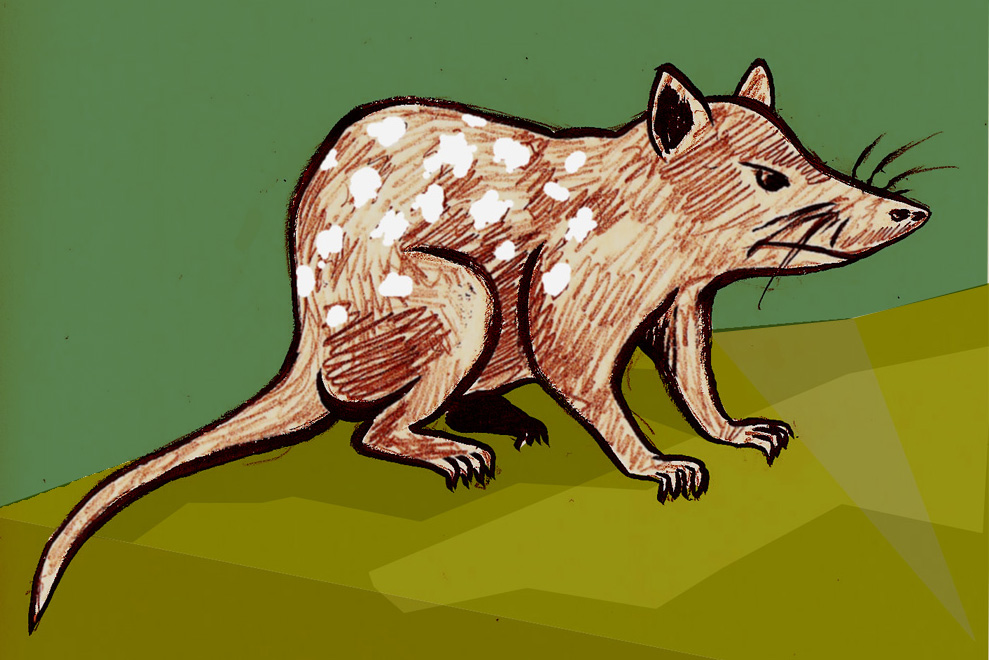
And so, let me also present to you the largest living* marsupial predator in mainland Australia, and the second-largest living marsupial predator of all:

That's a tiger quoll. There are several species of quoll, all living in relatively small areas of Australia or New Guinea. They're about the size of housecats, I think, though the tiger quoll is the biggest of the bunch.
If you're wondering who the largest marsupial predator is (by weight), then please allow him to introduce himself.
I don't think my drawing actually does a good job of capturing the quoll's personality — its quollities, if you will. My initial doodles might actually have been a bit more quollified for that task.

And I kept wondering, as I thought about the quoll this week, why it starts with a Q instead of a K. There are, as I mentioned before, lots of antipodean animals whose names kick off with a K.

Have you kids met Keanu?
Why a quoll and not a kwall? Why a quokka, not a kwokka? Who can explain orthographical orthopraxis? Ah, alas.
*Speaking of "alas," the qualifier "living" has to appear in my lists of marsupial predators because of the almost certain demise, in the last century, of the thylacine, a.k.a. the Tasmanian wolf or the Tasmanian tiger. It lived long enough to be photographed, but not long enough for me to meet it. [Sadface emoticon here.]
Monday, July 18, 2011
Animal Alphabet: P is for Pangolin
This week's entry in the Animal Alphabet is "Another armored animal..."

Here's a link to an ARKive video that will show you the funny bipedal walking that Marianne Moore describes in her poem.
The pangolin is the only mammal that is covered with scales.
Real overlapping scales have evolved in four places in the history of life on earth, as far as I know. The most obvious is in a subset of the reptiles (lizards and snakes). The name of that group, the squamates, derives from the Latin word for scale.
Can you tell me the other two groups of animals that have overlapping scales? Both groups are extant, not extinct.
Sunday, July 10, 2011
Animal Alphabet: O is for Olm
This week's entry in the Animal Alphabet is the olm.
It's not the first salamander we've seen in the alphabet: Meredith Randazzo did a mudpuppy, Lupi did an axolotl, and just last week Andrew Neal did a newt. But I'd bet that this salamander might be the strangest.
I wouldn't be surprised if you haven't heard of it. It's a very rare creature, and its habitat is confined to the caves of the Dinaric karst (on the Balkan peninsula). By the people of Slovenia, it is called "the human fish," on account of its coloration, which is really a lot like waterlogged caucasian human flesh.
It also had a reputation, back in the old days, for being a newly hatched dragon. So I guess that's the second one of those that I've drawn.

As you can see, what we have here is not just an olm, but an olm ouroboros.
It's my second nearly transparent underwater critter in a row, and I'm really not having a lot of luck coloring them in Photoshop. But I couldn't say no to the olm.
I've actually been working on a poem about the olm and its ecologically threatened position; in the poem I call the olm "the eft of the fontanelle" and play off of the fact that it belongs to the Proteus family. There's more, but I can't publish the poem here because I am still trying to find a print venue for it. One factoid that didn't make it into the poem is that olms, extremely long-lived on account of their very slow metabolisms, can survive for many years (at least six, some sources say ten) without a meal.
Here is some ARKive video of the olm so you can see that serpentine little body in motion.
I had originally planned, as you can see, a more naturalistic pose for my olm.

Eventually I settled on the ouroboros image when I saw that this week's Woot t-shirt derby is on the theme of "Things that Begin with O." If you've ever bought anything from Woot, you can vote for the olm behind this link.
It looks pretty good on a t-shirt, don't you think?
Monday, July 4, 2011
Animal Alphabet: N is for Nudibranch
For the Animal Alphabet this week, I have drawn a creature I didn't even know about when the project started.
Well, actually, I've been a fan of nudibranchs for a long time. But I had never seen Melibe leonina, the hooded nudibranch (or lion's mane nudibranch), until I caught it in an episode of Blue Planet.
You can see some footage of them here, on ARKive, and I think you'll see why I might have wanted to draw them.

First of all, I wanted to try to figure out how they're put together. I have never worked through more sketches in an attempt to figure out a critter's anatomy, I tell you. It took me several drawings before I noticed those two ear-like rhinophores on the back of the hood. I'm not sure about the number of wings or flippers.
And I'm still not sure that I've managed to capture the weird translucent net-ball-hood thing that is the head of Melibe leonina.

Another reason I was drawn to them was the bizarre body plan. These nudibranchs look like something from out of the Burgess Shale, and not like something that should be alive on this planet today. And in fact these weird things are plentiful, as you can see in some of the shots in that ARKive video.
The more I drew them, the more I realized that I was recognizing bits and pieces here and there. For a while they were looking like a monster I drew frequently when I was in like third grade.
(It looked like this. It was an outer space monster, so it didn't need limbs.)

Right now, my sense is that the recipe for a hooded nudibranch is about two parts jellyfish, two parts cow's tongue, two parts venus flytrap, one part dumbo octopus, one part Pac-Man, one part slug, and one part vagina dentata.
Next week: a blind cave-dwelling creature.
Well, actually, I've been a fan of nudibranchs for a long time. But I had never seen Melibe leonina, the hooded nudibranch (or lion's mane nudibranch), until I caught it in an episode of Blue Planet.
You can see some footage of them here, on ARKive, and I think you'll see why I might have wanted to draw them.

First of all, I wanted to try to figure out how they're put together. I have never worked through more sketches in an attempt to figure out a critter's anatomy, I tell you. It took me several drawings before I noticed those two ear-like rhinophores on the back of the hood. I'm not sure about the number of wings or flippers.
And I'm still not sure that I've managed to capture the weird translucent net-ball-hood thing that is the head of Melibe leonina.
Another reason I was drawn to them was the bizarre body plan. These nudibranchs look like something from out of the Burgess Shale, and not like something that should be alive on this planet today. And in fact these weird things are plentiful, as you can see in some of the shots in that ARKive video.
The more I drew them, the more I realized that I was recognizing bits and pieces here and there. For a while they were looking like a monster I drew frequently when I was in like third grade.
(It looked like this. It was an outer space monster, so it didn't need limbs.)

Right now, my sense is that the recipe for a hooded nudibranch is about two parts jellyfish, two parts cow's tongue, two parts venus flytrap, one part dumbo octopus, one part Pac-Man, one part slug, and one part vagina dentata.
Next week: a blind cave-dwelling creature.
Monday, June 27, 2011
Animal Alphabet: M is for Moloch
This week's Animal Alphabet entry goes by a few different names. I have a couple of other things I'm considering for T, though, so I won't be calling this a "thorny dragon" or a "thorny devil." Instead, I will give this little lizard its most awesome monicker, which it shares with one of Satan's fallen angels: it's the moloch, also known as Moloch horridus.

Seriously, I'm sort of a collector of scientific binomials—among my favorites are Gorilla gorilla and Bison bison—and Moloch horridus is about as cool as they get. Extra points for the etymological joke about the word "horrid" (which used to mean something closer to "horripilating," as you know, and seems to refer to the hundreds of thorny spikes sticking out from the moloch's hide).
The moloch is not related to the horned frog familiar to me from my Texas youth. Rather, the moloch lives in the Australian desert and is actually a lot spinier than the horny toad. Its spines are all keratin (not bone), and the texture of its skin gives the moloch the bizarre ability to wick water up from its feet to its face by capillary action. (Here's a link to a video that shows this miracle in action.)
What my drawing really doesn't capture is the weird jerky gait that the moloch uses, perhaps to confuse predators. For that, you have to refer to a different video or my preliminary doodles for this week.

"Moloch whose mind is pure machinery! Moloch whose blood is running money! Moloch whose fingers are ten armies! Moloch whose breast is a cannibal dynamo! Moloch whose ear is a smoking tomb!"
Anyway, I have a couple of creatures in mind for next week, and I'm having trouble choosing between them. Do you have a preference? I have a poll for you; you'll have to click through to vote if you're reading this by RSS.
What critter should I draw for the letter N?
Monday, June 20, 2011
Animal Alphabet: L is for Lungfish
A quick "Animal Alphabet" post this week, mostly because I don't have a lot to say.
You see, in my mental zoo, L has to be for Lungfish. Such has it always been.
Besides, it's been a while since I drew a weird fish.

I have always thought these guys are cool, since I was maybe three years old. When their ponds and pools dry up, they can hibernate under the mud, or they can slither off through the air looking for a deeper hole. I think if you grow up knowing about the existence of oddball animals like these, you're much more likely to appreciate Darwin's insights.
I realize that by doing a semi-amphibious fish this week, I'm pretty much robbing myself of "mudskipper" for next week, but I have something else planned (a lizard with an awesome name).
Monday, June 13, 2011
Animal Alphabet: K is for Kaka, Kea, and Kakapo
This week's Animal Alphabet entry is a threefer, because I couldn't decide between the three living members of the Strigopidae family.
That's right, antipodean parrot fans: this week, K is for Kaka, Kea, and Kakapo.

While I was picking a critter for this week's post, I started noticing how many of the iconic animals of Australia and New Zealand start with k. As of the point when I'm writing this, we already have Animal Alphabet entries for the kookaburra and the kiwi, and there's no reason we couldn't see the kangaroo or the koala.
I'm not sure why there are so many K-creatures down under, although I imagine it must have to do with both the prominence of the hard C in the native languages and the historical ascent of K as a way to spell that sound in English, perhaps as part of a general drift away from Latinate spellings for the things of the larger world. (After all, English had names for none of these critters before Captain Cook and Joseph Banks hit the Southern Hemisphere in 1769. That's pretty recent, in terms of the history of the language.)
Anyway, since I had decided to focus on three of the parrots peculiar to New Zealand, and since I can't think of New Zealand without thinking of its greatest cartoonist, I decided to include a local character of his (who also starts with "K") as an appropriate tour guide to the parrots.
Monday, June 6, 2011
Animal Alphabet: J is for Jerboa
This week's "Animal Alphabet" drawing comes with a fragment of a poem by Marianne Moore, one of my favorite poets.

That's the last couple of stanzas of "The Jerboa," because J is for Jerboa. You can click the pic to make the words legible.
If you have any questions about this critter, I refer you to the Moore poem. It starts on p. 10.

That's the last couple of stanzas of "The Jerboa," because J is for Jerboa. You can click the pic to make the words legible.
If you have any questions about this critter, I refer you to the Moore poem. It starts on p. 10.
Monday, May 30, 2011
Animal Alphabet: I is for Isopod
This week's Animal Alphabet entry is not in itself an obscure creature. In fact, I bet you know these guys by one of their several familiar names: the pillbug, the doodlebug, the sowbug, the roly-poly, the woodlouse, the armadillo bug, the chuggypig, the ticklebug...

Let me refer to them by a more general name:
I is for Isopod
They're a common enough critter in the ground-cover and leaf-litter that probably every kid has played with them at some point. They're harmless and interesting, and they behave according to predictable instincts.

I probably spent hundreds of hours with these guys between ages three and thirteen.
Did you know they're not insects? They've got seven pairs of legs (insects have three) and no wings or winglike structures. In fact, the lowly isopod is a crustacean, more closely related to shrimps, crabs, lobsters, and crawdads than to beetles or even centipedes.
Did you, moreover, know they have closer marine relatives? In fact, there are gigantic marine isopods. (They also live in Lake Baikal.)
These guys do not look quite so harmless.

Seriously. They can weigh almost four pounds. No lie.
Subscribe to:
Posts (Atom)